
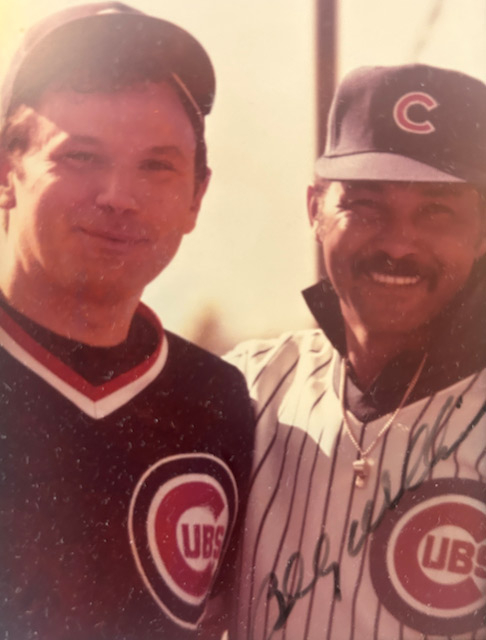
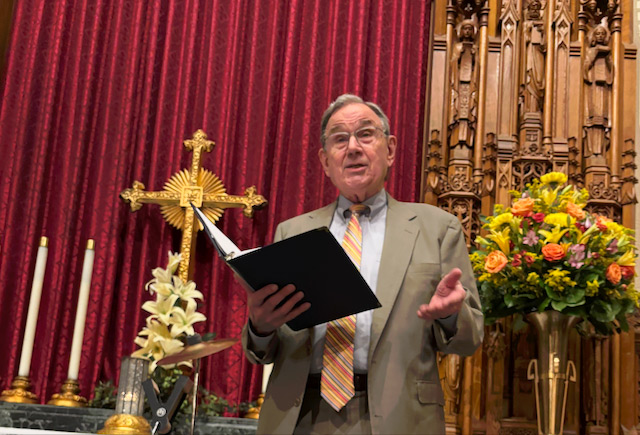
Mark Fedota may be the only Sounds Good singer who has spent time on the ballfield with Cubs superstar Ron Santo, TV talk show pioneer Phil Donahue, and the Pulitzer Prize-winning journalist Mike Royko. Mark—who sings with the Oak Park choir and serves on the Sounds Good board of directors—describes himself as a “show-off… I like the performance. I’m a trial lawyer by training, so I stand up—or used to stand up—in a courtroom and try to make a speech and convince people to do things.”
In addition to the superstars he met on the ballfield (more about that later), Mark learned the fine art of trial law under the tutelage of Philip Corboy, a legendary attorney dubbed “The Jack Nicklaus of trial lawyers” by a former clerk. Mark joined Corboy’s then-new firm shortly after graduating from Georgetown Law School. “That gave me the opportunity to try several hundred cases to verdict in the first four or five years of my practice.” Mark recalled. “I always said it was the moral equivalent of a surgical residency at Cook County Hospital.”
Asked what he is most proud of in his law career, Mark replied, “I think it’s being able to tell a story to a jury about a doctor in a case where it looks like all hell has broken loose. Many times patients and their families don’t understand the complexity of everything that went on. And when the result of medical treatment doesn’t come out completely right, the first tendency is to say the doctor must have done something wrong, because on TV and in the books the doctor performs miracles and everybody recovers. The most important thing I think I figured out is that people—patients—don’t listen to their doctors when the doctors talk to them. And so part of my job was to be able to persuade a jury that what the doctor did in treating the patient was what was supposed to have been done in those circumstances.”
Mark has given lectures on storytelling to doctors: “Talk to the patients, talk to the jury, explain things to them in ways that they can understand. Talk about orthopedic surgery in terms of carpentry and electricity, the nerves and the bones and how they work together.”
Having represented both sides in malpractice cases—plaintiffs with the Corboy firm and practitioners in his firm, FedotaChilders, Mark believes the wisest course is often to settle the case rather than go to trial: “I came away from a lot of situations feeling that not only could I practice better medicine than some of the folks I encountered, but I could also do better surgery,” he said with a chuckle. Like all expert practitioners, Mark acknowledges that, “You get to the point where there are younger people who can do a better job. One of the fellows that I was in law school with has found that in his profession, it’s probably time to slow down a little bit.” (That classmate was Dick Durbin, who is retiring from the U.S. Senate this year.)
These days Mark practices law “when the spirit moves me… I can do it at my own pace. I can offer counsel to people. And I’m learning new things,” he said, citing Sounds Good Choir as an example. “I’d had nothing to do with not-for-profit organizations until Bob Horner [former president of the board] persuaded me to join the Sounds Good board.”
Sounds Good Choir leaders are glad Mark said yes to Bob’s entreaty. Co-founder and artistic director Jonathan Miller said, “Mark has helped me think much more clearly about several important issues, and especially to better understand my role as the leader of the conducting team. He has helped the organization, overall, to do better at setting clear expectations and boundaries, and he does all of this with a sense of humor and humanity.”
Executive director Anne Schankin adds: “Fair warning: a conversation with Mark may run long, but you’ll walk away wiser and smiling. From reviewing contracts to stepping up as board secretary, he shows up whenever we need him. His steady counsel and generous spirit have been invaluable to our organization, and to me personally. Mark listens as deeply as he serves, and that’s a rare gift.”
Time to get back to the ballpark…
Having grown up in Chicago where, as Mark puts it, “You grew up in a parish or a park” (in his case, St. Cornelius Parish and Jefferson Park), he played that singular Chicago game known as 16-inch softball. He took a ball and a softball bat (“it looks like an extended milk bottle”) with him to Georgetown Law and introduced his classmates to the game. (Off the field, Mark was editor-in-chief of Res Ipsa Loquitur, the Georgetown Law quarterly magazine.) In later years, he got to know Mike Royko, a champion of the 16-inch game, but not on the ballfield. Rather, it was a racquetball court. “I’d come into the locker room and there was Mike Royko sitting back, sucking a Pall Mall and soaking wet from sweat.”
Mark’s baseball roots are deep. “The world’s greatest baseball fan was Dorothy Strutzel Fedota, my mother,” he says with pride. “My birthday is April 15th, and she would take me and a couple of my buddies out to Wrigley Field for a baseball game. I was also an altar boy, and one year she had to explain to the nuns that I couldn’t make it to a rehearsal for Holy Week services. One of the nuns asked, ‘What’s more important, baseball or God?’ And my mother looked at her and said, ‘Just don’t go there.’” As an adult, Mark became a Cubs season ticketholder. “I took my mother to the very first game I attended with my season tickets,” he recalled. “Mom loved to go to Ladies Day at Wrigley Field, when any woman over the age of 18 got in for free. On cold days she would look for the biggest guys she could possibly find and sit behind them because they stopped the wind blowing up into the grandstand. And she would wear her full-length mink coat because it was warm.”
As a season ticketholder, Mark had access to the Stadium Club at Wrigley. One day, Mark told Dorothy he would meet her at the club for a pre-game lunch, but he was delayed in court. “I get to the ballpark in the second inning. Mom’s in the seat, wearing her mink coat, and she’s got this silly look on her face. I said, ‘Now what’s wrong?’ And she said, ‘I got thrown out of the Stadium Club.’ I could not imagine how you could toss a middle-aged woman out of the club. But she happened to be wearing (this was before August 8th,1988) a yellow T-shirt that said, ‘No lights in Wrigley Field.’ But they didn’t throw her out because of what the shirt said. They threw her out because the shirt didn’t have a collar.”
“I have this reputation for having a short fuse,” Mark continued. “I charged into the Stadium Club with smoke visibly coming out of my ears and let them know exactly what I thought about them tossing my mother—let alone a client—out of the club. Two innings later, the manager showed up with two assistants and several bottles of a carbonated beverage that needs a license, to make amends and apologize.”
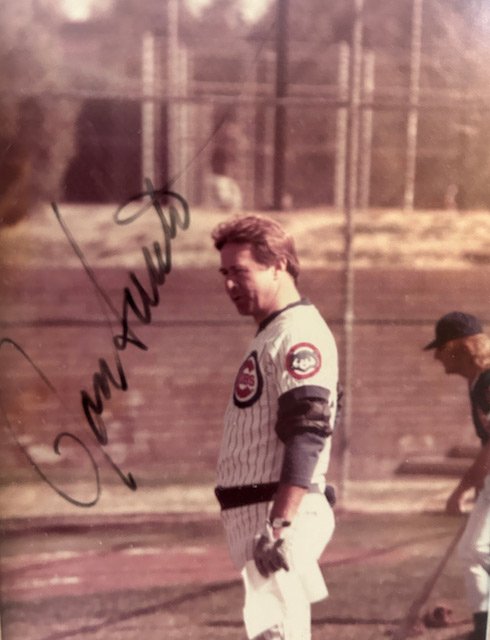
Mark’s encounters with Phil Donahue and Ron Santo happened at the Cubs’ Fantasy Camp during spring training in 1984—a 40th birthday gift from his wife, Cherie. A highlight for Mark was hitting a loud foul off Ferguson Jenkins, a Cy Young Award winner and three-time AllStar with the Cubs. (A “loud foul” is a hard-hit ball that sounds like it’s headed out of the park, but instead goes out of bounds.) Ron Santo, a Hall of Famer who went on to spend a number of seasons in the Cubs’ broadcast booth, was also at the camp.
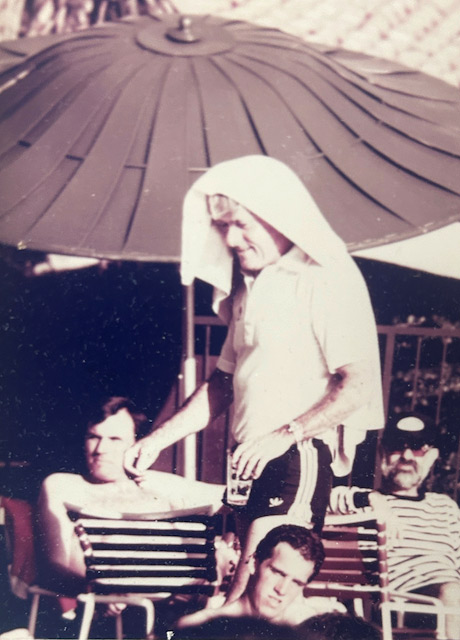
Phil Donahue was a fellow camper. “The campers spent time together at our hotel,” Mark recalls. “We would play baseball in the morning, and in the afternoon, we’d sit around the pool and drink, then go out to dinner. Phil was still filming his shows, and so the picture that I have of him is me sitting on a chair lounging with a drink and Phil walking by with a towel over his head to keep his hair the right shade and color for filming. We gave him a lot of gas about being there, and where was Marlo [Thomas, Phil’s spouse].”
Mark closes out his baseball memories with a tender story about a boy he encountered at his son Matthew’s youth baseball practice. “There was one little boy who clearly wanted to be there, but he was scared to death, and his mom was very protective of him. I said to her, ‘You’ve been watching me with these other kids. Do you trust me with Jimmy for a minute or two?’ She nodded, and I said, ‘Just go away and don’t say anything.’ I walked up to Jimmy and I said, ‘Jimmy, this is a baseball. I’m going to throw it at your chest. (I’m standing about two feet away.) I said, ‘Put your hands down at your sides. I want you to feel this hit you in the chest.’ And I tossed the ball at him and I said, ‘Did it hurt?’ And he said no, and I said, ‘I’m going to do it again. Doesn’t hurt, does it? You’re bigger than the ball. Now open the glove up, and I’m going to throw the ball into your glove, and you’re going to catch it.’ We did this a couple of times, and I said, ‘You go out in the field and you can catch the ball, but it’s OK if you miss it.’ The kid goes out there, and about two innings into the game, a pop-up goes out into right field, and he staggers around, and somehow the ball lands in his glove. Wow. I’ve never seen a mother and a grandfather as happy as they were at that point.”
Mark has some concerns about what might be termed the loss of innocence in youth sports. He and Cherie paid close attention to Matthew and his sister Jennifer, who played soccer, during their high school and college sports careers. “We had to watch them very, very closely so that untoward things didn’t happen. We stayed on top of stuff to make sure that there wasn’t an undue influence anyplace.”
These days, Mark enjoys following the high school and college sports adventures of his five grandchildren. “One of the great things about having them grow up and go to all of these schools is Grandpa plays a lot of golf. So, Grandpa has birthdays, and if you give him golf shirts from the undergraduate schools you’ve been to, it’s a nice gift and he is really happy. So, I have shirts from Villanova and USC and Cal Poly—all over the place.”
Mark’s devotion to music parallels his devotion to sports. “Growing up as a jock boy in grammar school, the boys played baseball and the girls took piano lessons from the nuns. But then I went to high school at Quigley Seminary, and music was a big deal—not only singing, but learning music theory. And not only singing modern music, but Gregorian chant. By the time I got out of high school, I had sung in a number of choirs, and the director had me sing a cappella in Holy Name Cathedral.”
While in college at Loyola, Mark got into musical theater: “It was a great opportunity to meet girls because community theater was always looking for males who could sing. I often got to be the heavy. I shot Billy Bigelow in Carousel, and I was one of the guys who chased Harry Beaton in Brigadoon to break the spell.”
Resuming his interest in music with Sounds Good Choir has not only brought Mark joy, it has deepened his appreciation of the benefits that music brings to older people. “I didn’t realize at the time how much my father-in-law, who sang in a church choir and enjoyed singing, benefited from that experience. I watched him, even as he aged and time took its toll, retain his memory of music. That realization was a little bit of what got me into Sounds Good, along with the long-term study on the effects of music on aging. Being a cheapskate, or at least parsimonious, when Sounds Good said, if you will sign up, it’ll cost you this much, but if you’ll sign up as part of the study at Northwestern, we’ll give you a little bit of a discount. Well, I signed up.”
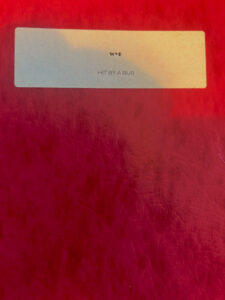 Mark’s mindfulness about aging extends to the responsibility to put things in order for those we leave behind. Enter the Red Book. “There’s a couple of people in my life who know about the Red Book. I got the idea from The West Wing, the TV series set in the White House. Leo McGarry, the Chief of Staff (played by the late John Spencer), has a book entitled Hit By a Bus. It contained all the essential information that would be needed in a national emergency.” Mark decided to create his own version of the book while awaiting knee surgery at Northwestern Hospital. “In the next bed was a gentleman who was clearly on his way out,” Mark recalls. “I remember vividly when his son came in, sat in the chair, leaned in and said very loudly, ‘Pa! Pa! Where’s the key to the box?’” In that moment, Mark asserts, “I swore my kids would not have to look for the key to the box. In Mark’s version of “Hit By A Bus” are all the account numbers, contacts, telephone numbers, where the keys are, all of that sort of thing. My kids are on the West Coast. I don’t want to leave them with a problem. They’re not going to have to go through pages and pages and drawers and file cabinets. It’s all there in the Red Book.”
That’s wise counsel from a wise counselor!
*(If you missed when it first ran from 1999 to 2006, or are looking for a heartwarming and hopeful political drama, The West Wing is available on several streaming platforms.)
Wow, what a wonderful, fun writer you are, Mark Fedota…thank you!!!
Thanks for another inspiring profile, Helen!