
Elizabeth posed a question to me recently that I haven’t been able to let go of: what did each of the four Beatles bring to the phenomenon we call The Beatles? Not “who was the best,” but a deeper question: what particular ingredient did each of them supply, such that if you had pulled any single one of the four out of the mix, the whole thing would have collapsed?
As many of you know, I’m trained as musicologist (you never fully get over that); I think in numbers and patterns since I’m a former math nerd; and I’ve been married to a clinical psychologist for 21 years, which means I’ve absorbed a working vocabulary for personality and family systems by sheer osmosis, mostly over morning coffee, during two decades. So, through that composite lens: for each Beatle, I want to ask three questions at once—what musical talent did he contribute, what personal or emotional quality did he bring, and was there anything else, something that doesn’t fit neatly in either box?
I’m going in reverse order of fame—Ringo, then George, then John, then Paul—because Ringo is the most underappreciated Beatle, and once you’ve heard more about him, the other three come into sharper focus.
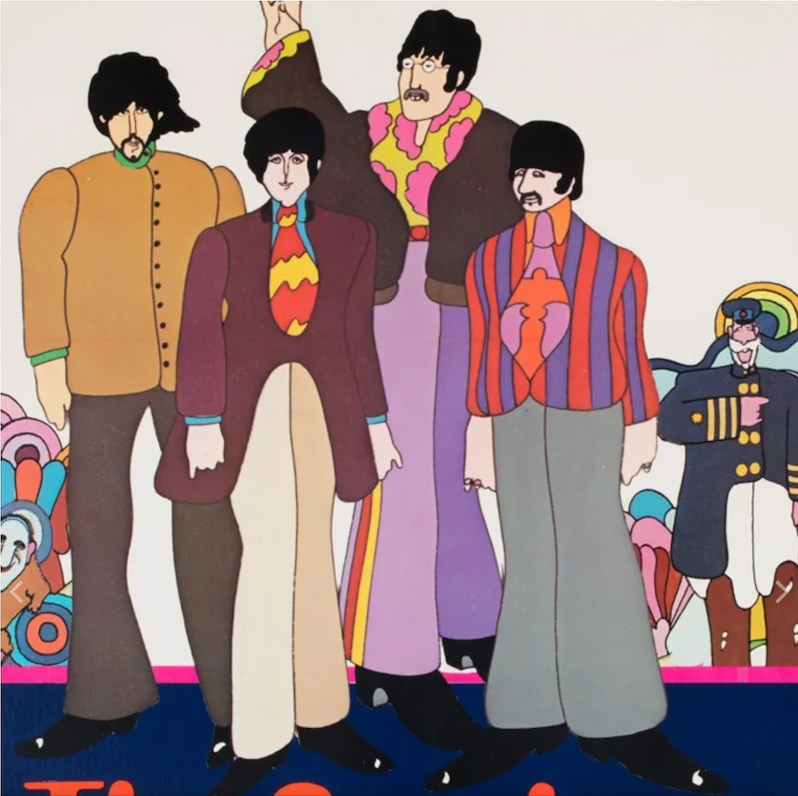
Each Beatle is represented here by art director Heinz Edelmann’s novelty clothing hangers. The hangers were designed as official promotional merchandise to tie into the release of the 1968 animated musical film “Yellow Submarine.” Modeled after the psychedelic, two-dimensional aesthetic that Edelmann created for the film, the hangers allowed fans to physically “dress” the Beatles in their own clothes when hung in a closet.
Ringo Starr
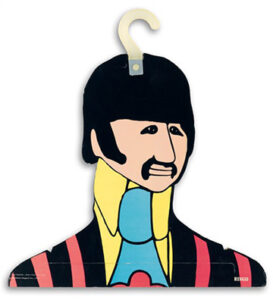 You already know the pejoratives: Ringo was the lucky one, the guy who got the gig, the drummer who wasn’t really a Beatle the way the other three were. It’s a joke that has long since outlived its evidence, and I want to spend a minute retiring it.
Musically, Ringo’s real gift was restraint in service of the song. He almost never played a fill because he could—rather, he played the fill the song needed, and then he stopped. Overdoing it was not his thing. Go listen to “A Day in the Life,” where the drumming under that famous orchestral buildup is doing something genuinely strange and syncopated and nobody talks about it. Or listen to the tom-heavy groove on “Come Together,” which is basically the song’s entire identity. McCartney and Lennon both said, more than once, unprompted, that Ringo was the right drummer for the Beatles specifically—not a generically great drummer (Keith Moon or Phil Collins come to mind), but one whose feel and taste fit their songs. Ringo came to the drum kit sideways: left-handed (like Paul was on the bass), playing a right-handed kit, mostly self-taught. His time has a looser quality that a more rigorously trained drummer might have eschewed in favor of a certain kind of drive or precision. The “wrongness” about Ringo’s playing turned out to be exactly right.
Personally, Ringo was the equanimity in the room. Every account we have (from the other Beatles, not just those of their biographers) puts him as the low-ego stabilizer, the one who didn’t need to win the argument. The Beatles were built around two of the more towering egos in twentieth-century songwriting, and for Ringo to hold this position so that the whole thing didn’t explode after two years or so is not a small thing.
And beyond that: Ringo’s ordinariness was itself an asset. He was the audience’s way in, the one who seemed like he could plausibly be your buddy at the pub, and the films leaned on that hard. When you hear him singing the solo on “A Little Help from My Friends” or “Yellow Submarine,” you think, “Oh, that’s an ordinary guy, someone I can relate to. I’ll keep listening.” He also had, by a wide margin, the best comic timing of the four, and this was a funny bunch to start with. We sometimes feel a little sorry for Ringo, because he was so unspectacular, but this was exactly what the Beatles needed from him.
George Harrison
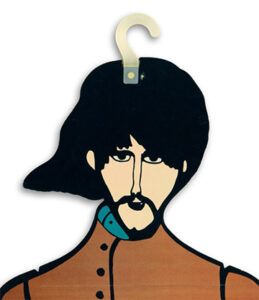 George’s story is all about patience and steady, deepening engagement and growth. He starts out by being fluent in the rockabilly guitar vocabulary of Carl Perkins and Chet Atkins—clean, economical, a little twangy—and by the middle of the decade he is pulling the whole band toward modal, drone-based harmony, the direct result of his study of Indian classical music with Ravi Shankar. George’s persistent yet low-key exploration is one of the main reasons the Beatles’ harmonic language expanded so dramatically between 1965 and 1968. Even setting the sitar aside, George had an ear for the minimal correct part—the guitar hook in “And I Love Her,” the volume-pedal swells on “Yes It Is”—economy over flash, in a decade that rewarded flash constantly. (We were talking in a meeting today, in a different context, about “minimum viable product,” and some of George’s guitar work seems the musical embodiment of that phrase—just right, understated sometimes, excellent in its conception and suitability, and not overdone.) He was the only one who could have come up with “Within You Without You,” still in my view one of the most remarkable songs the group ever recorded, pushing the sonic envelope of the Beatles far beyond its usual edges.
Personally, George spent years as the kid brother, chronologically and functionally. He was younger than the others. He came later than Paul and John to being taken seriously as a songwriter; he got one or two songs per album while Lennon and McCartney split the rest. His arc through the band is largely an individuation project—a quiet, and then increasingly less quiet, insistence on being heard as his own artist and not the junior partner. That tension is part of what makes “Something” and “Here Comes the Sun” land the way they do. They arrive as evidence, not just as good songs.
George’s post-breakup explosion of material, the huge release All Things Must Pass, is a triple album—which tells you something about how much had been held back. It also shows us how much restraint had gone into keeping the group’s internal balance intact. That restraint was a contribution too, even on the days when he was forced into taking a back seat.
John Lennon
John was the primal engine, rhythmically and emotionally.
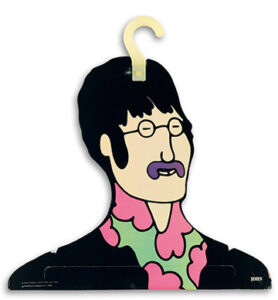 His rhythm guitar carries much of the early catalog’s harmonic identity: a lot of the sheer drive of “A Hard Day’s Night” or “I Feel Fine” is just the way John played the chords. His vocal melodies tended to take place in narrow ranges, close to the feeling of speech. “Nowhere Man” or “In My Life” (at least until the very end) are good examples of this, quite different from “Paperback Writer” or “Yesterday.” By this I mean that John’s sung lines sit near the natural contour of talking rather than reaching for vocal display, which is a big part of why his vocals feel so unmediated, like someone talking to you instead of performing at you. John was also the member most willing to let genuine strangeness into the music: drones, tape loops, dissonance, the edgy grit of “Revolution 9” or “Tomorrow Never Knows.”
Personally, John needed intensity to feel alive, and he generated it wherever he went. He was the honesty engine of the group—the one who’d say the thing everyone else was too polite to say (“We’re bigger than Christ”). On the downside, you get someone who needed conflict the way other people need quiet. Both were true at once, and the band somehow metabolized both sides of his energy for years.
And beyond that: John’s appetite for risk—artistic, personal, reputational—gave the whole group permission to be strange in public. Somebody in a band that ambitious has to be willing to look foolish first. John absorbed a disproportionate share of that risk on behalf of the other three, whether they thanked him for it or not. It might be argued that his intense and disruptive bonding with Yoko was the straw that broke the Beatles’ back, but in hindsight we could see, with more compassion, that he just needed to keep growing and experimenting (as she did) in every way possible, even if it meant the end of the band.
Paul McCartney
 Paul is the most complete musician of the four. His longevity and energy are astounding—only a few artists have kept cranking out new material at a high level for more than 60 years, and his most recent album, The Boys of Dungeon Lane, is at an unusually high level by all accounts.
The bass playing alone would justify the reputation: it works like melody, it works like counterpoint (its own melody that works well with the main tune), treating the bass as a second vocal line instead of a foundation you build on top of. This is not the way most people play bass. He had the widest melodic range of the group and the surest command of harmony and voice-leading, which is how the same writer produces both “Blackbird” and “Live and Let Die”—or, from my teenage era, “Silly Love Songs”—without any of those sounding like a stretch. He was also the group’s default arranger, the one who’d hear a string part or a piano figure for someone else’s song and just, well, know it. Even if he didn’t sing all the lines, the way Bobby McFerrin did with overdubbing himself, you can tell that Paul’s the one who heard the whole soundscape. (And if you haven’t heard Bobby’s recording of “Blackbird,” you should treat yourself.)
Personally, Paul was the organizer, the morale-keeper, the one who pushed projects across the finish line when the group’s energy sagged (“Abbey Road” being a huge example—see my recent “Golden Slumbers” blogpost for more on that). By the end Paul had become something like the band’s reluctant parent, holding a fraying family together mostly by force of will. That kind of exhausting work isn’t always appreciated in the moment.
And beyond that: Paul’s optimism and drive functioned as the group’s steam engine. You need someone who wants to finish the album, book the studio time, keep the machine running on the days nobody else feels like it. (Sandy sometimes plays this role for me, both at Sounds Good and in our home life; she’s the one who reminds me to just “get it done” on those Sunday evenings when I really don’t want to find yet one more large object from the basement to go to the curbside so that our shoveling-out project can make progress.) Paul’s quality of relentless persistence is perhaps a less romantic contribution than Lennon’s risk-taking or Harrison’s spiritual expansion, but they wouldn’t have gotten so much music to the finish line any other way.
So, what’s the whole picture?
There’s also the “fifth Beatle,” producer George Martin, who seems to have been influential in many ways. He was “establishment,” having come up at the EMI label and the BBC in an era of great formality in the business world. He figured out how to let the Beatles fly with weird stuff (like “A Day in the Life”) while keeping their work palatable to record executives. He seems to have been able to mediate the band’s four strong personalities with skill and sensitivity. While he was classically trained and could have had his own career, he spent much of the 1960s as the background guy, sublimating his ambition to be out front to facilitate the greatness of others. A quality that I find very touching in him is his willingness, like a good parent, to let those in his charge spread their wings and see what happens. Very early on, in 1962, when he felt forced to decide whether John or Paul should be the lead singer, he stopped himself: “Suddenly it hit me that I had to take them as they were, which was a new thing. I was being too conventional.” Thank goodness for the rest of us that he could indeed take them as they were.
So—if you’re sitting in rehearsal for our all-Beatles show, or listening to these songs again with fresh ears—which of these qualities do you find yourself drawn to? Are there places in your life where you play one or more roles similar to those of the Beatles? For example, in your family, do you hear yourself more as a Ringo, holding the group steady? Are you a George, quietly waiting your turn? Are you more of a ringleader like Paul or John? Do you bring out and encourage the gifts of others? Leave a comment and let me know. I’d love to get inside your imagination on this one.
Within my family, I am a George. In SG, I try to be a Ringo.
A very interesting read, Jon. Since I own over 50K lps, the largest chunk by one artist is definitely The Beatles, plus dozens of books about them, I obviously share a strong thread with growing up with The Fab Four in the 60’s. In fact, I don’t think I would trade my era (my awareness of how important they were coincided with the creative flowering of the gatefold album) with any other. Oh, I truly treasure the great American Songbook, which probably had its golden era in the ’20’s – ’30’s -40’s, yet so many rock singers (Sir Paul among them) seem to feel the need to cover these standards also. Perhaps a topic for a future essay by you?
So glad you are a musicologist, Jonathan. Your words get us inside the songs, to appreciate some of the musical reasons we are so drawn to the exterior/performance of them. Going to listen right now to Bobby McFerrin Blackbird, though it can’t top my favorite version by the incomparable Jon Baptiste!
Jonathan: These blogs are fascinating. I think you should compile them in a book. “(Grace) Notes from a Musicologist”. Though I bet someone else could come up with a catchy title. Susan
What a wonderful essay on the Beatles, Jonathan! Thank you for writing and sharing this with the SG community. Great insight into each Beatle’s contribution and role with the group, including George Martin, who as producer, arranger and more played such a significant part in their music and evolution as a group.
And, congratulations on a great magical Beatles summer of music rehearsals and performances!
I have two memories. In late fall of 1963 I was listening when Ray Nordstrand played “I Want to Hold Your Hand” on the Midnight Special, the first time the Beatles had been heard in Chicago and perhaps the earliest broadcast in the United States. I searched with AI – it denied the event, but I taught it better and now it knows!
In the Spring of 1981 I saw the original manuscript of “Yellow Submarine” in the Manuscripts Saloon in the British Museum. AI confirmed this memory. Here is its commentary:
“The display in the Manuscripts Saloon during the spring of 1981 featured the original, handwritten lyric drafts of The Beatles, which famously included “Yellow Submarine” written by John Lennon and Paul McCartney.
The Permanent Loan:
In the late 1960s, Beatles biographer Hunter Davies deposited these precious handwritten lyrics—scribbled on scraps of paper, envelopes, and hotel stationery—on a long-term loan to the national collections.
Elevated to High Art:
By 1981, seeing these contemporary pop lyrics displayed behind glass in the Manuscripts Saloon alongside foundational national treasures like the Magna Carta, the Gutenberg Bible, and the handwritten works of William Shakespeare created a striking visual juxtaposition. It signaled a major cultural shift, treating modern rock lyrics with the same historical prestige as classical British literature.”
Well, I enjoy the Beatles, but its not high art!