

On August 22, 1969, two days after mixing and editing of the last track on “Abbey Road” — what be be their last time in the studio together — the Beatles showed up at Tittenhurst Park, John’s new house in Ascot, for what turned out to be the last set of photos taken together.
I’m writing this on July 2, 2026, exactly fifty-seven years to the day when Paul, George, and Ringo recorded the rhythm tracks and guide vocal, a total of fifteen takes, for the combination of songs known as “Golden Slumbers/Carry That Weight.” The songs were joined together with “The End” in post-production, and they are known now as a three-part medley. The group recorded to 8-track tape, with Paul playing piano on one track, Ringo playing drums on another, and George—uncharacteristically, but beautifully—playing bass guitar on a third. Our choirs for older adults are singing the three-song medley on our concerts in a few weeks, in a terrific choral arrangement—unusually faithful to the original vocals—by Tim Allen.
There was a poignant backdrop to the Beatles’ recording on that July day in 1969. John Lennon was in the hospital in Scotland, recovering from a serious car accident, when the other three Beatles did the work on this song. Not only John was badly hurt but also Yoko, their son Julian, and Yoko’s daughter Kyoko. It would be easy to have this situation bring up feelings of vulnerability in Paul and in the others in the studio on July 2. The band was on shaky ground in a few respects, and Paul was trying to keep it going on emotional life support, one might imagine by sheer willpower.
Four weeks later, between July 30 and 31, Paul recorded what is regarded as one of his finest moments as a Beatles vocalist, the lead vocal for “Golden Slumbers.” There is a combination of tenderness and longing at the opening, followed by a comforting strength and confidence at the refrain. Paul said later about his singing on this song: “I remember trying to get a very strong vocal on it, because it was such a gentle theme, so I worked on the strength of the vocal on it and ended up quite pleased with it.”
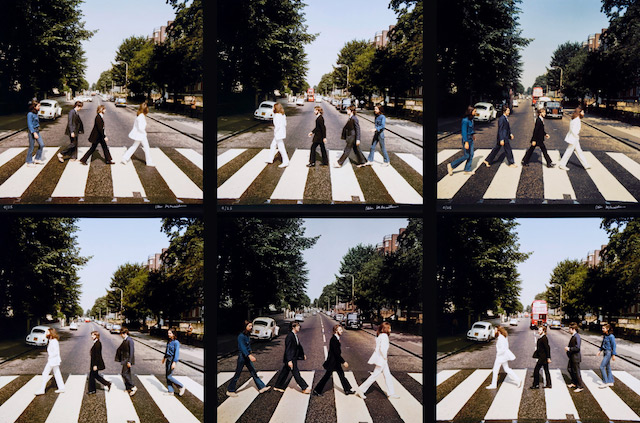
Photographer Iain Macmillan was given ten minutes to take photos for the cover of “Abbey Road,” while he stood on a step-ladder and a policeman held up traffic. He only took these six photos — three photos of the Beatles walking to the right, three of them walking to the left.
The Welsh folk music critic Jude Rogers—who is a writer for the Guardian and the BBC—wrote a superb article for the Financial Times about this song. She points out a few things that spoke to me. One is that, about nine months earlier, in October 1968, Paul had been visiting his father, in the house that Paul had bought for him, on the Wirral peninsula in north-west England. Paul was playing idly on the piano there and stumbled upon a book that belonged to his 8-year-old stepsister, Ruth. The book contained a song called “Cradle Song,” with lyrics from a 17th-century play by Thomas Dekker called Patient Grissil, in which a grandfather sings a lullaby to his grandchild with the following words:
Golden slumbers kiss your eyes,
Smiles awake you when you rise;
Sleep, pretty wantons, do not cry,
And I will sing a lullaby,
Rock them, rock them, lullaby.
Paul couldn’t read music, and he substituted “pretty darling” for “pretty wantons” while trying out these words to a tune that he was hearing in his head. He already had another song in mind to go with it, and most writers assume that this was “Carry That Weight.”
The other thing that Jude Rogers underscores in her article is this: nowhere in the centuries-old play do we find the words “Once there was a way to get back homeward / Once there was a way to get back home.” She writes, with the skill of a great music critic:
… these [words] were McCartney’s alone. Here was a man thinking about the comfort of families and homesteads as he sat by his father’s piano, in the dying days of his band.
Sadness lurks in “Golden Slumbers”’ melody from its very beginning. A piano figure pivots between a chord that suggests a major key, before dropping in a mournful lower sixth. Unusually, the strings also come in on this note, striking a strange, melancholy mood before its nursery-rhyme beauty lifts off.
It was clear that the Beatles weren’t going to last. Rogers concludes with this heartbreaking summary:
“Golden Slumbers” mourns those moments where we are looked after as children that we can never get back, before adulthood hits; then we have “carry that weight/a long time”. The year after he recorded “Golden Slumbers”, McCartney left The Beatles. He moved to southwest Scotland, to bring up his own children. He found a way to get back home.
As for me as a listener who loves lyrics, one of the remarkable parts of this lyric is the difference between “homeward” and “home.” They are not the same. The first one plunges us right into a feeling of longing, almost a feeling of safety: yes, Paul asserts, once we could make our way homeward, which is contraction of “home” and “toward,” a movement toward home. There is intense hopefulness here, a yearning for a familiar balm for those parts of our souls that feel exiled, homeless, lost, adrift. And there is fulfillment after the longing, at least a fulfillment that we can remember, because, as Paul tells us, once there actually was a way to get (all the way) back home. But it is in the past tense, he says, intensifying the longing for what is lost. Still, we are urged not to cry but simply to sleep; the elder who is rocking us can’t necessarily get us back there, but the lullaby can provide solace, just as this remarkable song does.
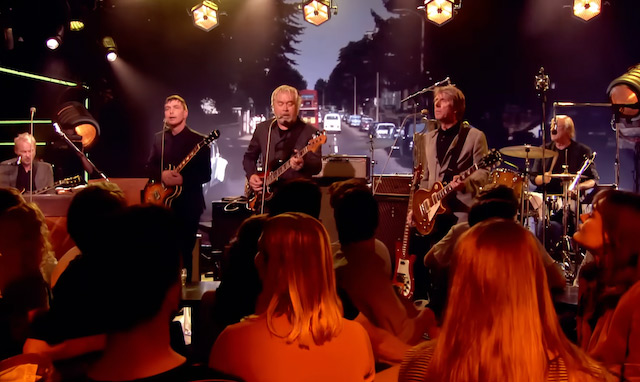
The Analogues, a Dutch band, singing the Beatles’ “Golden Slumbers.” – Watch the video
I’ll leave you with the cover by the Dutch band the Analogues: It’s an amazing live performance of amazing material.
Sleep, pretty darlings.
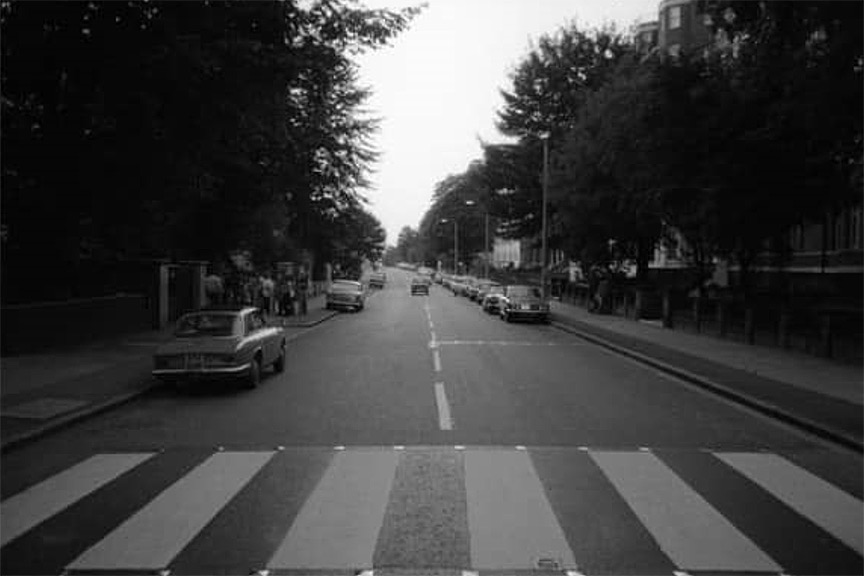
An empty Abbey Road.
Lovely story. Thank you, Jon.